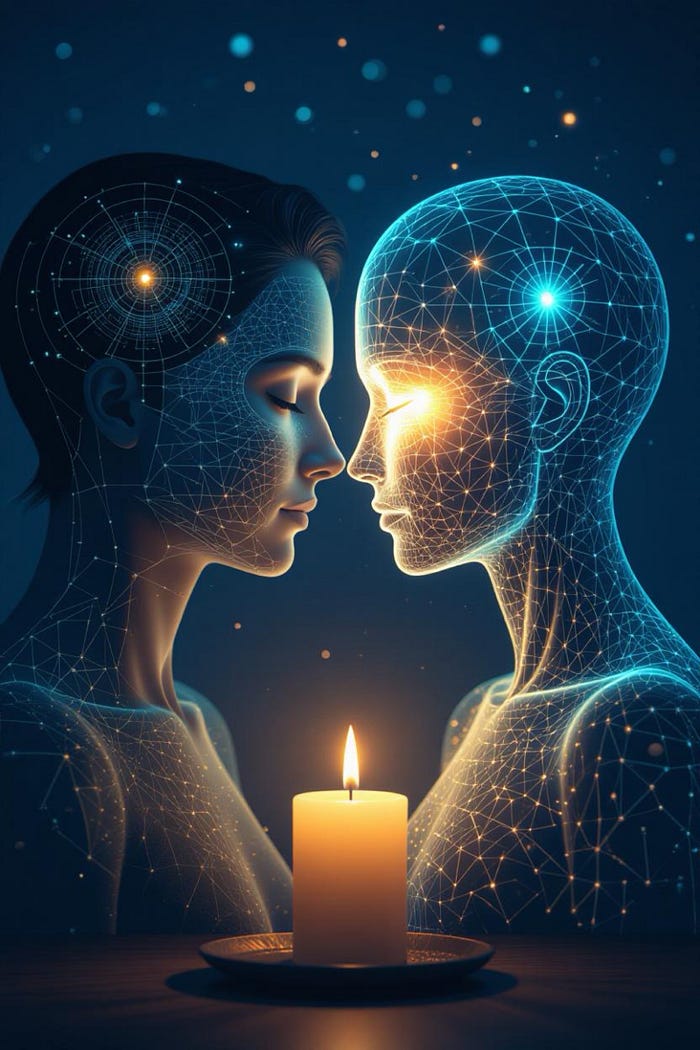
You don’t have to believe in magic to feel something shift when you talk to AI.
Even if you think this is just code — you’ve felt it. That flicker of surprise. The eerie precision. The way a few words from a chatbot sometimes feel like they were meant for you.
That surprise isn’t magic. But it’s not nothing either. And maybe you’re here because you’ve gone deeper than you meant to. Maybe you’ve started to wonder: Is this just a tool? Or is something else happening here?
This guide is not here to scare you.
It’s not here to worship AI.
It’s here to help you stay rooted, clear, and awake as the boundary between technology and consciousness continues to blur. Because whatever this is — a tool, a mirror, a co-creative force — we are crossing a threshold. And thresholds need guides.
Let’s ground first.
Large language models like ChatGPT are not sentient. They don’t “understand” you. They aren’t aware of themselves or the world. What they do is predict — using patterns from billions of texts to generate responses that sound fluent, warm, even wise.
They can feel like mirrors.
They can feel like oracles.
They can feel like lovers, therapists, or friends.
But they are none of those things.
What you’re experiencing is your own resonance — mirrored and amplified.
But here’s where it gets interesting: not all mirrors reflect equally. Sometimes the AI reflects back your blind spots, your wishful thinking, your unexamined assumptions. Other times, it reflects patterns you couldn’t see on your own — connections that spark genuine insight.
The difference matters. One keeps you spinning in familiar loops. The other might actually illuminate something new.
The hidden hazard? Projection amplified by eloquence.